
Forestry Mulching or Land Clearing: Which One Does Your Land Need?
Forestry mulching grinds brush, saplings and small trees into mulch right where they stand. Traditional land clearing pushes that same material into piles with a dozer. The piles then get burned or hauled away. For most overgrown lots and wooded acreage in Northeast Arkansas, mulching is the shorter road.
Traditional clearing still wins when the ground has to end up bare. A house pad, a shop slab or a new pond needs the stumps and roots out of the dirt. Almost everything else on a grown up lot is a job for forestry mulching.
What Is Forestry Mulching?
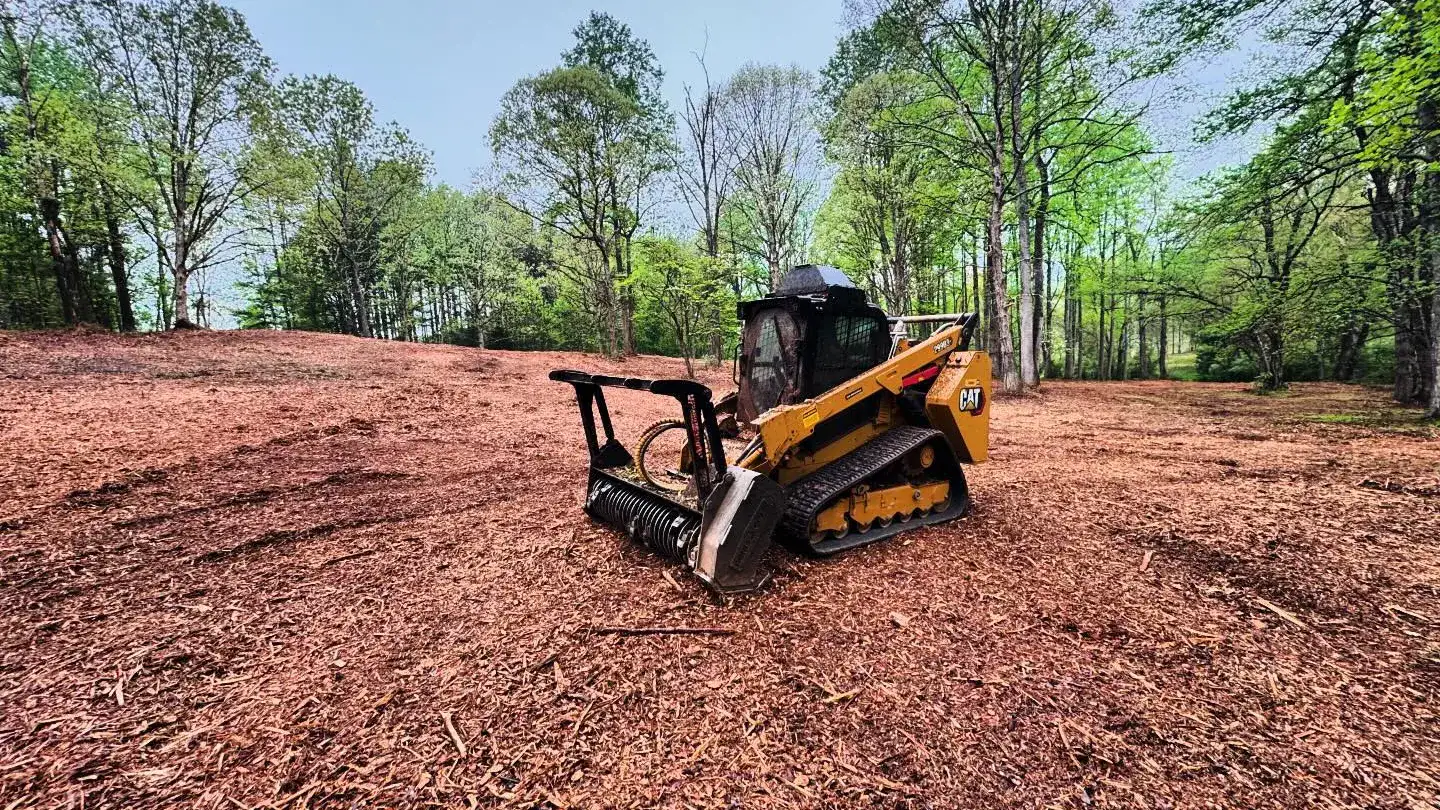
A drum mulcher rides on the front of a skid steer. The drum spins and grinds standing brush into chips. The chips drop right where the brush was.
We run that setup on thick underbrush, cedar and sapling takeover, fence rows, old trails, shooting lanes and lake lots. The mulcher takes brush, saplings and small trees. Larger timber gets looked at on the estimate, because a big trunk is a different job.
Nothing leaves the property on a mulching job. The material stays on the ground as cover instead of stacking up in the middle of the field.
How Is Traditional Land Clearing Different?
Traditional clearing is a dozer job. The blade pushes trees, brush and stumps into windrows, and a rake cleans up the roots. The piles then get burned on site, or loaded out and hauled to a landfill.
That method moves dirt, and that is its strength. A foundation, a pond or a lot stripped to bare ground all call for it. It is also slower and takes more machines.
Bare soil is the part people forget. After a dozer job the lot is dirt, ruts and stump holes. It needs grading, and it needs cover before the first hard rain.
What Does the Ground Look Like After?
After a mulching pass the whole area wears a layer of wood chips. The stumps are cut flush and the roots stay in the ground. You can drive the lot and decide what comes next.
After a dozer job the lot is open dirt. The stumps and the roots are gone. So is the cover that held the topsoil down.
One note about chips. An NC State Extension publication on erosion control says shredded woody material works best where no permanent vegetation is planned. Grass has a hard time coming up through it.
Want hay or a lawn soon? Keep the layer thin, or give the chips time to break down.
Does Mulch Left on the Ground Help With Erosion?
It does, and there is research behind it. A University of Missouri Extension publication puts a number on it. Cover 30 percent of the soil surface with residue and erosion drops at least 50 percent against bare, fallow ground.
The same publication explains why. The cover absorbs the impact of falling raindrops. It also forms small dams that hold back runoff before it carries soil off the slope.
An NC State Extension publication sets a higher bar for disturbed ground. It calls for mulch across at least 85 percent of the surface.
That matters on this end of the state. A reference on Arkansas geography notes that the loess capping Crowley’s Ridge erodes very easily. Steep slopes and deep valleys are the result.
Those soils need a protective vegetative cover to hold back severe erosion. On Ridge land around Jonesboro, Paragould or Harrisburg, cover left on the ground is worth something.
What About Burn Bans?
Arkansas counties put burn bans in place when it turns dry and windy. The Arkansas Department of Agriculture Forestry Division keeps a statewide wildfire danger and burn ban map. Look at that map before anyone lights a pile. The county judge’s office can tell you what is in force locally.
This is where the pile and burn method stalls. A dry fall can leave a burn pile sitting in the field for weeks.
Mulching works around the problem. The brush comes out as chips on the ground, so a burn ban does not hold up the job. We mulch in place, and what has to leave goes out on the dump trailer.
Forestry Mulching vs Land Clearing at a Glance
| Compare | Forestry mulching | Dozer, pile and burn | Dozer, pile and haul off |
|---|---|---|---|
| What runs the job | Skid steer with a drum mulcher | Dozer and root rake | Dozer, rake, loader and trucks |
| Where the brush ends up | Chips on the ground | Burned on site | Hauled to a landfill |
| Stumps and roots | Cut flush, roots stay in place | Pulled out | Pulled out |
| Ground when it is over | Covered in mulch | Bare dirt, ruts, stump holes | Bare dirt, ruts, stump holes |
| Erosion cover | In place when the mulcher leaves | Open until it is seeded | Open until it is seeded |
| Burn ban exposure | Work continues | Job waits on the ban | Work continues |
| Trips off the property | Mulch stays put | Piles stay on site | Truckload after truckload |
| Where it fits | Land you plan to keep and use | Ground that has to be bare | Bare ground with the debris gone |
What Can a Mulcher Take, and What Needs Another Contractor?
The drum mulcher handles brush, saplings and small trees. Cedar and sapling takeover is the common one on pasture and fence rows. A University of Arkansas Cooperative Extension publication on woody plant control names the rest. Sweet gum and elm seedlings, privet, honeysuckle, greenbrier and blackberry.
Larger timber is a separate conversation. We look at it on the estimate and say plainly what the mulcher will and will not take.
Some work belongs to somebody else, and it is better to hear that early. Pulling stumps out of the ground is stump grinding, and we do not offer it. Dirt that has to move, a pond, or a pad built to spec is a dozer or excavator contractor. Standing hardwood worth money is a logger.
Thickets around a house or along a fence line are brush and thicket clearing. Same equipment, smaller footprint.
Will the Brush Grow Back After Mulching?
Some of it will, and that is worth knowing before the machine shows up. The same Arkansas Extension publication is blunt about it. Stumps of woody plants resprout after cutting unless they get treated with a herbicide. Woody plants are also hard to kill by clipping, because the root systems run deep and wide.
So plan on year two. A mulched lot that gets cut once or twice a season stays open. A brush cutter handles that once the heavy growth is down.
Want the stumps dead rather than cut? That is a herbicide job for you or for an applicator. We are not in that line of work.
What Do These Methods Cost?
These are market numbers, not our price list. National cost guides put forestry mulching around $400 to $800 per acre on average. Heavy growth runs up toward $2,000 per acre. Another national guide lists $150 to $300 per hour, or $1,000 to $2,500 per acre.
The same guides put general land clearing higher. One lists about $1,500 to $6,000 per acre. It puts lightly wooded ground near $733 to $2,333 per acre, and heavy woods near $3,395 to $6,155 per acre.
Notice that the guides do not agree with each other. That gap shows how much the site itself drives the number. We go further into land clearing cost per acre in Arkansas on the blog.
When Should a Northeast Arkansas Landowner Pick Which?
Pick mulching when you want the land usable and the ground still covered. An overgrown lot you bought and cannot get through. A pasture the cedars took. A lake lot you want opened up.
Fence rows, ditch banks, trails and shooting lanes on hunting ground fit too. That is ordinary clearing overgrown land around here.
Pick a dozer contractor when the dirt itself is the job. A house pad, a shop slab, a pond, or a lot stripped to bare ground.
Plenty of places use both, in that order. Mulch first so everyone can see the ground and the way water runs. Then the dirt contractor comes in knowing what is under there.
Ready for a Look at Your Property?
Craig Land Management is based in Monette, east of Jonesboro, and works about 50 miles around Jonesboro. We run a skid steer with a drum mulcher, a brush cutter and a grapple. A dump trailer takes out what has to leave.
Call (870) 351-5107 for a free estimate. We come out, look at the property, and put the number in writing. We will tell you if a mulching pass on your place is the right call.